Discover the best mountain biking in Ladakh, top 7 routes, best time, costs, and expert tips for a safe and unforgettable Leh Ladakh bike ride in 2026.
Mountain biking in Ladakh is not just a sport, it is one of the most extraordinary physical adventures available anywhere in India. Imagine pedalling through a landscape so vast and dramatic that every turn reveals a new mountain, a frozen river, or a 1,000-year-old monastery perched on a cliff. That is what biking in Ladakh feels like, every single day on the trail.
Positioned at an average altitude of 3,500 metres in the Himalayan and Karakoram ranges, the Leh Ladakh bike ride experience is unlike any other cycling destination in the world. The roads and trails here range from relatively smooth valley routes to lung-busting climbs over the world's highest motorable passes. You can spend a gentle afternoon cycling between ancient monasteries along the Indus River, or you can take on the legendary ascent to Khardung La at 5,359 metres, a challenge that earns every cyclist genuine respect.
What makes mountain biking in Leh Ladakh truly special is the combination of physical challenge, natural beauty, and cultural immersion. You are not just riding through scenery, you are crossing passes that ancient Silk Road caravans once used, pausing at Buddhist shrines, and waving at villagers who have lived at altitude for generations.
Whether you are a seasoned cyclist with high-altitude experience or a keen rider trying Ladakh biking for the first time, this guide covers all seven major cycling routes, the best season, costs, and practical tips to help you ride smart and ride safe.
Key Takeaways
Ladakh offers 7 major mountain biking routes, from easy day rides around Leh to multi-day epic routes across high passes.
The best time for mountain biking in Ladakh is June to September, when all roads are fully accessible.
Acclimatise for at least 2 full days in Leh before attempting any serious cycling, altitude affects even very fit riders.
A sturdy front-suspension or full-suspension mountain bike is essential for Ladakh's rough terrain.
Bicycle rentals in Leh cost approximately ₹600–₹1,500 per day depending on the bike quality.
Permits (Environment Fee) are required for restricted-area routes like Pangong Tso and Nubra Valley, apply at lahdclehpermit.in.
Top 7 Mountain Biking Routes in Ladakh at a Glance
Route
Distance
Duration
Difficulty
Best For
1. Pangong Tso
~150 km one way
2–3 days
Hard
Experienced cyclists
2. Warila–Khardung La–Nubra & Sham
~200+ km
5–7 days
Expert
Expedition cyclists
3. Spangmik, Man, Merak & Changla Downhill
~30–40 km from Pangong
1 day (at lake)
Moderate
Cyclists already at Pangong
4. Leh to Zingchen
~16 km one way
Half day
Easy–Moderate
Beginners, acclimatisation rides
5. Skiu to Chilling
~30–35 km
1–2 days
Moderate–Hard
Fit cyclists with off-road experience
6. Stok, Stakna & Thiksey Monasteries
~45–65 km
1 day
Moderate
Cultural riders, intermediate level
7. Leh to Sankar Gompa, Shanti Stupa & Namgyal Tsemo
~20–25 km loop
Half day
Easy
Beginners, first-day riders
Route 1: Pangong Tso, The High-Altitude Lake Ride
Cycling to Pangong Tso (Pangong Lake) is the ultimate bucket-list Leh Ladakh bike ride. The lake sits at 4,225 metres above sea level on the India-China border, and the road that takes you there crosses Chang La Pass at 5,360 metres, one of the highest motorable passes in the world.
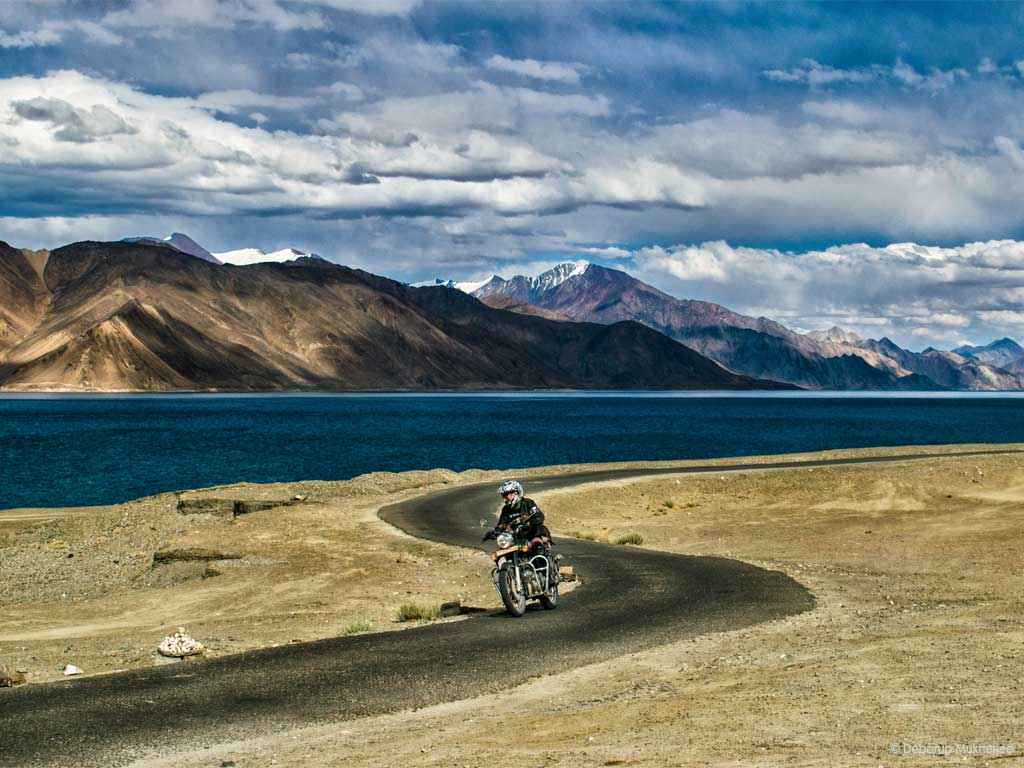
The visual reward at the end of this ride is unmatched. Pangong Lake stretches for 134 km, with its surface shifting between shades of sapphire, turquoise, and deep blue depending on the time of day and light. The sheer stillness of the lake after the physical exertion of the ride creates an emotional impact that cyclists consistently describe as one of their most powerful travel memories.
The total distance from Leh to Pangong Lake is approximately 150 km one way. The first 47 km from Leh to Sakti is relatively flat, gaining only around 300 metres in altitude. After Sakti, the road climbs steeply for 28 km to Chang La at 5,360 metres. Once you cross the pass, it is mostly downhill or flat riding to the lake's edge.
Key Details
Detail
Information
Route
Leh → Sakti → Chang La → Durbuk → Tangste → Spangmik
Distance
~150 km (one way)
Chang La altitude
5,360 m (17,590 ft)
Pangong Lake altitude
4,225 m (13,862 ft)
Best time
June to September
Duration
2–3 days (with overnight at Pangong)
Difficulty
Hard
Cost
Bicycle rental ₹600–₹1,500/day + accommodation + permit
Highlights
Crossing Chang La Pass, one of the world's highest motorable passes, the climb is steep and the air is thin, but the views are staggering
Riding through Durbuk and Tangste villages, small traditional Ladakhi settlements that see relatively few tourists compared to Leh
Arriving at Spangmik village on the banks of Pangong, the main tourist area at the lake, with camping and homestay options
Waking up at dawn beside the lake, when the water reflects the mountains in the most extraordinary light
Permit Required
A valid Environment Fee (formerly Inner Line Permit) is mandatory to access Pangong Tso for Indian nationals. Apply online at lahdclehpermit.in before your trip.
Route 2: Warila–Khardung La–Nubra Valley & Sham, The Expedition Route
This is the most ambitious of all mountain biking routes in Ladakh, a true multi-day expedition that takes you over two high passes, through remote valleys, and into the cold desert of Nubra. It is designed for serious, experienced cyclists who want an adventure that tests both their fitness and their resolve.
The route begins in Leh and travels east through the Sakti Valley via Wari La Pass (5,262 m), a less-visited alternative to the more famous Khardung La. You descend into the Nubra Valley, explore the sand dunes and Bactrian camels of Hunder, and then climb back over Khardung La Pass at 5,359 metres on the return to Leh. Many itineraries also include a loop through the Sham Valley, a quieter, lower-altitude stretch along the Indus River with ancient monasteries and traditional villages.
What makes this route exceptional is the combination of landscapes. In the space of a single expedition, you ride through barren mountain desert, a cold Himalayan desert with actual sand dunes, fertile river valleys lined with willow and poplar trees, and past centuries-old Buddhist monasteries.
Key Details
Detail
Information
Route
Leh → Sakti → Wari La → Nubra Valley → Hunder → Khardung La → Leh (+ Sham Valley option)
Distance
200+ km total
Key passes
Wari La (5,262 m), Khardung La (5,359 m)
Best time
July to September
Duration
5–7 days
Difficulty
Expert
Cost
Guided expedition: ₹25,000–₹40,000 per person (10-day package)
Highlights
Wari La Pass is a newer, less-crowded route that very few international cyclists have explored, a genuine off-the-beaten-path achievement
Hunder Sand Dunes in Nubra Valley, cycling across actual desert terrain surrounded by snow-capped 6,000-metre peaks is a strikingly surreal experience
Khardung La descent, 45 km of exhilarating downhill from 5,359 metres back to Leh, with views of the Shyok Valley spread below you
Sham Valley monasteries and villages, where life has changed little in centuries
Permit Required
Environment Fee (formerly Inner Line Permit) is required for Nubra Valley. Apply at lahdclehpermit.in before your trip.
Route 3: Spangmik, Man, Merak & Downhill from Chang La, The Pangong Shoreline Ride
This route is best done as an extension when you are already camping or staying at Pangong Lake after completing Route 1. Once you have crossed Chang La and reached Spangmik, the lakeside ride to the villages of Man and Merak is one of the most scenic, and most underrated, day rides in all of Ladakh.
The three villages of Spangmik, Man, and Merak sit along the southern shore of Pangong Lake, each approximately 10 km apart. The road runs parallel to the lake, giving you continuous views of the water as its colour shifts with the angle of the sun. The further you ride from Spangmik towards Merak, the fewer tourists you encounter, and the more you feel the genuine remoteness of this part of India.
This is also where Pangong Lake reaches its widest and most dramatic stretch. The mountains on the far (Chinese-controlled) shore rise directly from the water with no beach or transition, it is a visual spectacle that no photograph fully captures.
After exploring the lake villages, many cyclists return to Leh by enjoying the long downhill from Chang La, which provides an exhilarating, mostly gravity-powered descent back to the valley floor.
Key Details
Detail
Information
Route
Spangmik → Man → Merak (and return) + Chang La downhill to Leh
Distance
~30–40 km (Spangmik to Merak and back) + 75 km downhill to Leh
Key altitude
Pangong Tso: 4,225 m; Chang La: 5,360 m
Best time
June to September
Duration
1 day (lakeside ride) + 1 day return to Leh
Difficulty
Moderate (lakeside); Hard (Chang La climb if returning that way)
Cost
No additional rental cost if combined with Pangong route
Highlights
Cycling along the turquoise shoreline of Pangong Lake, the lake is on your left and barren Himalayan mountains on your right for the entire ride
Man and Merak villages are traditional Changpa nomadic communities, quiet, deeply authentic, and far removed from tourist footfall
The Chang La downhill is one of the great freewheel rides in India, 75 km of mostly descending road back towards Leh
Route 4: Leh to Zingchen, The Perfect Acclimatisation Ride
The Leh to Zingchen route is the most accessible and beginner-friendly mountain biking route in Ladakh. It is ideal for your first or second day of riding after arriving in Leh, serving as both an acclimatisation activity and a genuinely enjoyable introduction to Ladakh's terrain and culture.
Zingchen is a small village located approximately 16 km from Leh city, on the road that leads towards the Hemis National Park and the popular Markha Valley trekking route. The ride follows a valley road that climbs gradually along the Indus River, passing through traditional Ladakhi villages, apricot orchards in summer, and patches of green farmland that contrast beautifully with the barren mountain slopes above.
The road surface is mostly manageable, the altitude gain is gradual, and the scenery is representative of the best of central Ladakh. Many cyclists also combine this ride with the beginning of a longer trek, riding to Zingchen, leaving the bike, and continuing on foot towards Skiu or the Hemis valley.
Key Details
Detail
Information
Route
Leh → Choglamsar → Karu → Zingchen
Distance
~16 km one way (32 km return)
Altitude at Zingchen
~3,600 m
Best time
June to October
Duration
Half day (3–4 hours return)
Difficulty
Easy–Moderate
Cost
Bicycle rental ₹600–₹1,500/day
Highlights
A relaxed valley road with relatively light traffic, ideal for riders getting used to cycling at altitude
Passing through traditional Ladakhi villages with whitewashed stone houses, prayer flags, and terraced fields
Choglamsar, a Tibetan refugee settlement just outside Leh, with a vibrant market and cultural centre worth stopping at
The ride can be extended into a combination day, cycling to Zingchen, then trekking further into the Hemis landscape before returning
Route 5: Skiu to Chilling, The Zanskar Valley Off-Road Ride
The Skiu to Chilling route is one of the most dramatic off-road biking experiences in Ladakh, combining rough terrain, river crossings, canyon landscapes, and genuine remoteness in a way that no valley road can replicate.
Skiu is a small village deep in the Hemis National Park, accessible from Zingchen. Chilling is the starting point for Zanskar River rafting, located at the confluence of the Zanskar and a smaller tributary. The route between the two passes through the lower section of the Markha Valley trail, the Zanskar Canyon, and the Kandala Pass at approximately 4,900 metres.
This route is often done as part of a multi-activity combination, many adventurous travellers cycle from Leh to Zingchen, trek from Zingchen to Skiu, then cycle from Skiu onwards to Chilling, followed by a rafting trip from Chilling down the Zanskar River to Nimo. It is an extraordinary three-activity adventure that covers land, trail, and water in a single extended trip.
Key Details
Detail
Information
Route
Zingchen → Skiu → Chilling (through Hemis National Park)
Distance
~30–35 km (Skiu to Chilling)
Key altitude
Kandala Pass: ~4,900 m
Best time
July to September
Duration
1–2 days
Difficulty
Moderate–Hard
Cost
Guided day: ₹2,500–₹5,000 per person including support
Highlights
Riding through Hemis National Park, one of India's largest national parks and home to snow leopards, blue sheep, and other Himalayan wildlife
Canyon walls and gorge terrain, the landscape between Skiu and Chilling is among the most visually dramatic in all of Ladakh
The natural combination with Zanskar River rafting from Chilling to Nimo, cyclists who complete this full adventure describe it as the most complete day of outdoor activity in their lives
Very low tourist traffic on this route, giving a true sense of wilderness
Route 6: Stok, Stakna & Thiksey Monasteries, The Indus Valley Culture Ride
This route is the finest balance of cycling adventure and cultural exploration in Ladakh. It takes you along the southern bank of the Indus River through three of the most impressive and historically significant monasteries in the entire region, all within a single day's riding distance from Leh.
The ride begins with a drive to Stok (about 20 km south of Leh), where you visit the Stok Palace Museum, the former royal residence of the Ladakhi kings, now converted into a museum housing ancient artefacts, royal robes, and Tibetan Buddhist relics. You then begin cycling northward along the Indus River, passing through Stakna Monastery (perched dramatically on a rocky hill above the river) and Thiksey Monastery, often compared to Lhasa's Potala Palace for its architectural grandeur.
The road is paved, the gradient is manageable, and the scenery of the Indus Valley, willow trees, stone walls, terraced fields, and the river flowing silver against brown mountains, makes this one of the most beautiful cycle rides in India.
Key Details
Detail
Information
Route
Leh → Stok Palace → Stok village → Stakna Monastery → Thiksey Monastery → Leh
Distance
~45–65 km (depending on return route)
Altitude
3,500–3,600 m throughout
Best time
June to October
Duration
Full day (6–8 hours including monastery visits)
Difficulty
Moderate
Cost
Bicycle rental ₹600–₹1,500/day + monastery entry fees (~₹30–₹100 per site)
Highlights
Stok Palace Museum, a genuinely fascinating collection of Ladakhi royal history, with ancient weapons, ceremonial robes, and an extraordinary collection of Tibetan Buddhist art
Stakna Monastery, founded in the 16th century by a Bhutanese lama, the approach by bicycle, with the gompa rising above you against a backdrop of mountain peaks, is one of the great visual moments of any Ladakh cycling tour
Thiksey Monastery, home to one of the largest statues of Maitreya (the Future Buddha) in Ladakh, standing 15 metres tall across two floors of the monastery building
Riding along the Indus River road with minimal traffic, willow-lined paths, and the river flowing alongside you
Route 7: Leh to Sankar Gompa, Shanti Stupa & Namgyal Tsemo, The Leh City Loop
This is the ideal first cycling day in Ladakh, a relatively compact loop around Leh city that takes in three of the most iconic landmarks in the region without venturing too far from town. It is the perfect route for completing your acclimatisation, getting comfortable with your bicycle on Ladakhi roads, and experiencing the atmosphere of Leh itself before heading to more remote routes.
The loop begins in central Leh on Fort Road, heads north through the willow-lined lanes of Changspa towards Sankar Gompa, a working monastery just 3 km from Leh's main market, then climbs to the iconic Shanti Stupa, the gleaming white Buddhist peace pagoda built by Japanese monks that offers the best panoramic view of Leh city and the surrounding valley. The route then continues to Namgyal Tsemo, the hilltop gompa that watches over Leh from its craggy perch above the old town, before a scenic descent back through the old city streets.
Key Details
Detail
Information
Route
Fort Road, Leh → Changspa → Sankar Gompa → Shanti Stupa → Namgyal Tsemo → Old Leh → Fort Road
Distance
~20–25 km loop
Altitude
3,500–3,700 m
Best time
Year-round (weather permitting)
Duration
Half day (3–4 hours)
Difficulty
Easy (with one steep climb to Shanti Stupa)
Cost
Bicycle rental ₹600–₹1,500/day
Highlights
Sankar Gompa, a beautifully maintained monastery just minutes from central Leh, housing a remarkable collection of Buddhist paintings and statues. Far fewer tourists visit here than the more famous Hemis or Thiksey monasteries
Shanti Stupa, the steep climb to the stupa is genuinely hard on a bicycle at altitude, but the 360-degree view of Leh, the Indus Valley, and the mountains is the finest panorama available in the city
Namgyal Tsemo Gompa and Fort, a 15th–16th century fortress-monastery complex above Leh Palace that guarded the eastern approaches to the valley; the ride up is challenging but the views are exceptional
Old Leh city, the descent brings you through the historic Muslim quarter and the ancient city lanes, making this as much a cultural tour as a cycling ride
Best Time to Plan Mountain Biking in Ladakh
Choosing the right time for your Leh Ladakh bike ride is as important as choosing the right route. Ladakh's climate is extreme, summer is brief but wonderful, and winter shuts most roads for months.
Month
Conditions
Roads
Recommended?
January–February
−20°C; severe cold
Most roads closed; air access only
❌ Not recommended for cycling
March–April
Cold; unpredictable
Srinagar–Leh opens ~late March
⚠️ Only for very experienced winter riders
May–June
Warming up; snow melting
Roads opening; Manali–Leh opens ~mid-May
✅ Good, fewer crowds, fresh snow on passes
July–August
15°C–25°C; peak season
All roads fully open
✅ Best overall, maximum accessibility
September–October
Cooler; clear skies
Roads open until October
✅ Excellent, best visibility, post-monsoon clarity
November–December
Rapidly cooling
Roads begin closing November
❌ Not recommended
The overall best window is July to September. For experienced cyclists who prefer quieter roads, May–June and September–early October offer the same routes with fewer fellow tourists on the road.
Mountain Biking Cost Guide for Ladakh
Here is a practical breakdown of what mountain biking in Ladakh actually costs.
Expense
Cost Range
Notes
Bicycle rental (basic mountain bike)
₹600–₹1,000/day
Suitable for Leh city routes and easy valley rides
Bicycle rental (quality front-suspension MTB)
₹1,000–₹1,500/day
Recommended for monastery routes and Zingchen
Bicycle rental (premium full-suspension MTB)
₹1,500–₹3,000/day
Essential for Pangong, Khardung La, and Nubra routes
Guided day cycling tour (with support vehicle)
₹2,500–₹5,000/person
Includes guide, mechanic support, and emergency backup
Multi-day guided mountain biking package (7–10 days)
₹25,000–₹40,000/person
Includes accommodation, meals, permits, bike, and support
Environment Fee (Pangong/Nubra restricted areas)
₹400 base + ₹20/day
Apply online at lahdclehpermit.in
Accommodation per night in Leh
₹800–₹3,000
Budget guesthouse to mid-range hotel
Camping near Pangong
₹1,500–₹3,000/night
Usually includes dinner and breakfast
10 Essential Tips for Biking in Ladakh
Tip 1, Acclimatise Before You Ride: Never start cycling seriously on Day 1 or Day 2 in Leh. Your body needs time to adjust to the altitude. Spend your first two days walking gently around the town, staying hydrated, and resting. Beginning to cycle before proper acclimatisation significantly increases your risk of Acute Mountain Sickness (AMS).
Tip 2, Choose the Right Bicycle: The terrain in Ladakh demands a proper mountain bike with good suspension. A flat-bar hybrid or city bicycle will be uncomfortable and potentially unsafe on rocky mountain roads. For Pangong, Nubra, or the Skiu–Chilling trail, insist on a quality front-suspension or full-suspension mountain bike from your rental provider.
Tip 3, Start Riding Early Every Morning: Ladakh's wind picks up significantly from midday onwards, and afternoon storms are common in July and August. Starting your ride by 6–7 AM gives you the calmest conditions, the best light for photography, and ensures you reach your destination safely before weather deteriorates.
Tip 4, Carry Adequate Water and Snacks: At high altitude, dehydration accelerates quickly, often without you feeling thirsty. Carry at least 2–3 litres of water per rider for any ride over 20 km. Pack high-energy snacks (nuts, dried fruit, energy bars) as food stops are non-existent on remote routes.
Tip 5, Wear Proper Sun Protection: The UV index at Ladakh's altitude is extremely high. Even on cloudy days, you can get severe sunburn in hours. Wear SPF 50+ sunscreen, cover your arms and neck, and always use quality UV-protective sunglasses. Snow blindness is a real risk near passes covered in snow.
Tip 6, Learn to Ride the Descent Carefully: Ladakh's great descents, particularly Khardung La and Chang La, are long, steep, and have sharp corners. Overheated brake pads are a genuine risk. Use your brakes intermittently rather than continuously on long descents. A support vehicle behind you on major descents is strongly recommended.
Tip 7, Always Carry a Basic Repair Kit: Punctures are common on Ladakh's rocky surfaces. Carry a puncture repair kit, spare inner tube, tyre levers, a pump, Allen keys, and chain lubricant. On remote routes like Skiu–Chilling or the Wari La expedition, a mechanical breakdown with no tools and no support vehicle can turn into a serious situation.
Tip 8, Book Reputable Rental Shops in Advance: During peak season (July–August), quality bicycles get booked out days in advance. Contact rental shops on Fort Road or Changspa Road in Leh before your arrival to reserve your bike. Inspecting the bike before you pay, checking brakes, gear shifts, tyres, and seat, is essential.
Tip 9, Carry Cash in Remote Areas: ATMs exist only in Leh city. Once you leave Leh for Pangong, Nubra, or the Zanskar valley, there are no banking facilities. Carry sufficient cash for accommodation, food, and any emergency expenses for the entire duration of your route.
Tip 10, Tell Someone Your Route and Expected Return: Mobile coverage disappears within 10–15 km of Leh on most routes. Before heading out on any multi-day ride, leave a copy of your intended route and expected return date with your guesthouse or a trusted contact. On remote routes, hiring a local guide with good mountain experience is strongly advisable.
Conclusion
Mountain biking in Ladakh is unlike any cycling experience in India or, indeed, anywhere in the world. The combination of extreme altitude, extraordinary landscapes, ancient cultural heritage, and genuinely challenging terrain creates something that goes far beyond sport. Every pedal stroke on a Leh Ladakh bike ride earns you a view that most people will only ever see in photographs.
Whether you choose the gentleness of the Leh city loop on your first afternoon, the cultural richness of the Indus Valley monastery route, or the full physical commitment of the Pangong–Chang La expedition, mountain biking in Ladakh will leave you with a sense of achievement that is difficult to replicate anywhere else.
Plan carefully, acclimatise properly, choose the right bicycle, get your permits sorted in advance, and always start early. Do all of that, and your Ladakh biking adventure will be among the most powerful experiences of your cycling life.
Frequently Asked Questions (FAQs)
Q1. Is mountain biking in Ladakh suitable for beginners?
Yes, but only with the right preparation and route choice. Complete beginners should start with the Leh to Sankar Gompa, Shanti Stupa & Namgyal Tsemo loop (20–25 km) or the Leh to Zingchen ride (32 km return), both of which are manageable for recreational cyclists at moderate fitness. The critical requirement for all beginners is proper acclimatisation, spend at least 2 full days resting in Leh before attempting any cycling. High altitude affects fitness disproportionately, and even very fit cyclists can find Ladakh's thin air surprisingly punishing on the first few rides.
Q2. What type of bicycle do I need for mountain biking in Ladakh?
For Leh city routes and the monastery loop, a basic mountain bike or hybrid bike is sufficient. For routes involving high passes like Khardung La or Chang La, or off-road terrain like the Skiu–Chilling trail, you need a quality front-suspension or full-suspension mountain bike with reliable disc brakes and multiple gears. Never attempt Ladakh's major routes on a road bike, city bike, or low-quality rental without suspension, the roads will be uncomfortable and potentially dangerous. Always inspect your rental bike thoroughly before signing the agreement.
Q3. Do I need a permit for mountain biking in Ladakh?
It depends on your route. You do not need a permit for cycling within Leh city or on routes that stay within the general Leh area (such as the monastery circuit or the Leh–Zingchen ride). However, for routes that enter restricted areas, specifically Pangong Tso, Nubra Valley (Khardung La circuit), Hanle, Tso Moriri, and the Chusul and Batalik sectors, Indian nationals must pay the Environment Fee (formerly known as the Inner Line Permit). Apply online in advance at the official LAHDC Leh portal: lahdclehpermit.in. Foreign nationals require a Protected Area Permit (PAP) from the DC Office in Leh.
Q4. What is the best month for a Leh Ladakh bike ride?
September is widely considered the best single month for mountain biking in Ladakh. The summer crowds have thinned, all roads and passes are still fully open, post-monsoon skies are exceptionally clear, the light is beautiful, and daytime temperatures are comfortable for cycling (typically 10°C–20°C). July and August are excellent for maximum road accessibility and festival activities but are busier. May and June are good for experienced riders who want to be among the first of the season on the trails, with snow still visible on high passes adding to the drama of the ride.
Q5. How much does a complete mountain biking trip in Ladakh cost?
For a self-planned, 7-day mountain biking trip including flights, accommodation, bicycle rental, permits, meals, and local transport:
Budget rider: ₹20,000–₹35,000 per person
Comfortable independent trip: ₹40,000–₹60,000 per person
Guided cycling package (bike, guide, support vehicle, accommodation, meals): ₹25,000–₹40,000 per person for 10 days
The most significant cost variables are your choice of accommodation (budget guesthouses vs. mid-range hotels), bicycle quality (basic rentals vs. premium mountain bikes), and whether you hire a guide and support vehicle. For multi-day remote routes like Pangong or the Nubra expedition, a support vehicle carrying your gear and offering mechanical backup is strongly recommended and significantly improves both safety and comfort.
Packages for this Destination
Expedition with Nubra Pangong Hanlay
7 days· from ₹13,740.13

Majestic Ladakh with Hanley
7 days· from ₹9,711.76
Classic Ladakh Circuit with Hanle, Umling La & Tso Moriri (Copy)
9 days
classic ladakh Umling la
11 days· from ₹23,388.57
Ladakh Delighted
7 days· from ₹11,843.32
Mystic Ladakh Escape
6 days· from ₹8,819.16